
People & Co. Consulting.
Compliance-Ready. Trauma Informed. Future-Fit.
Helping Australian venues meet workplace obligations while building emotionally intelligent, ethically-resilient teams.
Trauma-Informed Risk & HR Strategy | Psychosocial Hazard Specialists.
The Support You Need. The Compliance You Deserve.
At People & Co. Consulting, we understand what it’s like to operate in real-world environments… tight margins, shifting priorities, high staff turnover, and limited time to interpret evolving workplace obligations.
Our role is to support employers to understand and meet their responsibilities under WHS legislation and the Respect@Work reforms, in a way that is practical, proportionate, and aligned with how work is actually carried out.
We work alongside organisations to identify psychosocial and behavioural risks, implement required policies and prevention measures, and support leaders to understand their responsibilities at every level.
Rather than handing over documents without context, we provide structured guidance through each stage, supporting employers to put appropriate measures in place and maintain clear records of the steps taken.
Our approach is designed to support clarity, consistency, and confidence, assisting with prevention steps along the way, while recognising that responsibility for implementation and outcomes remains with the employer.
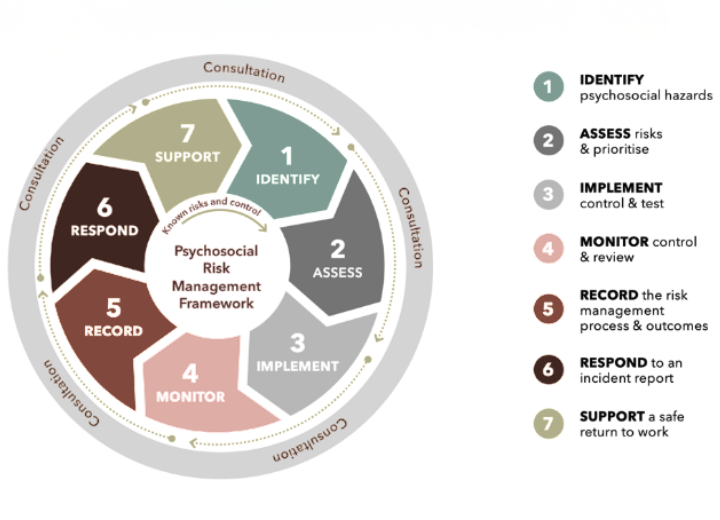
Psychosocial risks often hide behind absenteeism, burnout, silence, and stress. We help you identify these hidden hazards, then offer clear practical solutions for mitigation.
Workplace Risk Solutions.
-

Risk Assessments + Risk Registers
-

Compliance Training + Tracking
-

HR Strategy + Risk Reporting
-

Policy Development + Prevention Plans
Psychosocial Hazards: What Australian Workplaces Are Reporting
Psychosocial hazards relate to how work is designed, managed, and experienced, from all levels within a business. Common examples include excessive workloads, interpersonal conflict, bullying, and sexual or gender-based harassment.
Across Australia, these risks are now formally recognised as part of workplace health and safety obligations, requiring employers to take proactive and proportionate steps to manage them.
Since April 2023, employers have been required to identify and manage psychosocial risks, with a specific focus on preventing sexual and gender-based harassment under the Respect@Work reforms.
These changes reflect increased regulatory expectations that risks are identified early, appropriate controls are implemented, and organisations can demonstrate the steps taken to meet their obligations.
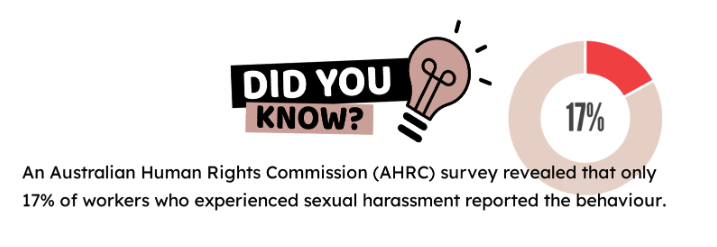
Psychosocial hazards are a legal responsibility, not just a cultural concern.
Psychosocial hazards are a legal responsibility, not simply a workplace consideration.
Managing these risks forms part of an employer’s duty of care under WHS legislation and requires appropriate systems, clear responsibilities, and informed leadership decision-making.
The Model Code of Practice for Managing Psychosocial Hazards at Work outlines expectations for identifying hazards, assessing risk, and implementing suitable control measures.
Alongside this, the Respect@Work reforms introduced a Positive Duty requiring employers to take reasonable and proportionate steps to prevent sexual and gender-based harassment.
Regulatory focus is increasing, with organisations expected to demonstrate how these obligations are being met in practice.
At People & Co. Consulting, we support venues and organisations to meet these requirements through practical, legislative-aligned strategies, supported with team training, documentation, and leadership guidance.
From March 2025, regulators will begin formally reviewing how organisations are meeting these expectations.
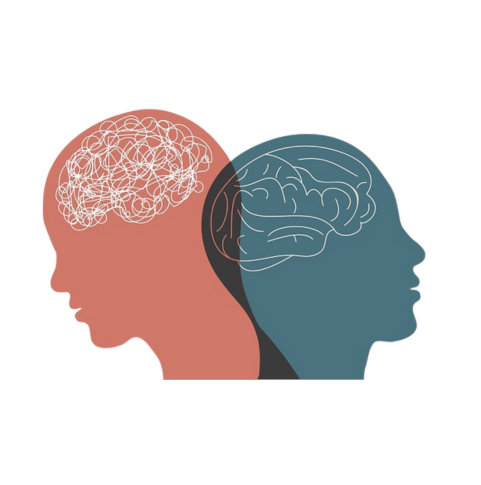
Every workplace holds pressure, but not every workplace holds it well.
Every workplace experiences pressure, but not all workplaces are equally equipped to manage it.
Across Australia, a significant proportion of mental health-related workers’ compensation claims arise from work-related stress, bullying, harassment, and interpersonal conflict.
Certain industries carry higher exposure to these risks, particularly those that are fast-paced, public-facing, or reliant on casual or shift-based workforces.
In sectors such as hospitality, retail, fitness, and real estate, factors such as customer aggression, blurred boundaries, and power imbalances can increase psychosocial risk.
Managing these risks effectively requires clear reporting pathways, appropriate training, leadership awareness, and documented processes, not just policies in the main office, but implemented and educated in everyday work practices.
How risks are identified, responded to, and recorded plays an important role in organisational stability, workforce retention, and regulatory readiness.
As you review your obligations, the following considerations can help you reflect on whether your current systems and processes are appropriately designed to manage psychosocial risk.
Questions Worth Asking in Your Business:
Are our current systems designed to identify and manage psychosocial risks early, or do issues tend to escalate before action is taken?
Do our reporting and response processes support timely and appropriate intervention?
How confident are we that employees understand how to raise concerns and what to expect if they do?
Are leaders equipped to recognise early indicators of stress, exclusion, or interpersonal tension?
Could aspects of how work is structured or managed unintentionally contribute to pressure or silence?
When was the last time our policies, training, and reporting pathways were reviewed through a psychosocial risk lens?
Are performance expectations balanced with appropriate safeguards for well-being?
If required, could we clearly demonstrate the reasonable steps we have taken to meet our obligations?
People & Co.
-

Compliance & Research
Specialist support sourced through our remote network of professionals, ensuring our clients stay aligned with current Federal and State-based legislation, industry standards, and emerging compliance requirements.
-

Founder & Principal Consultant
Flerida Milán leads client engagement, workplace risk assessments, prevention planning, policy implementation, and compliance training across Australia.
-

Design & Digital Content
Independent digital learning partners who support People & Co. with the creation of high-quality training materials, visual assets, and modern instructional design aligned with adult-learning best practice.
Next Steps
If you’re reviewing your compliance obligations or facing new team challenges, this 30-minute call is designed to meet you where you’re at.
We’ll explore your current practices, identify any gaps, and discuss a practical support package that prioritises your business while keeping you aligned with WHS and Respect@Work requirements.
Support is always scaled to your size, risk profile, and regulatory obligations.

Strategic Consulting, Human-Centred Delivery
Every venue is unique, but the foundations of a safe, compliant workplace are universal.
Every venue is unique, but the foundations of a compliant workplace are consistent.
While traditional WHS services have often focused on physical hazards, employers are now required to also consider psychosocial risks, including how work is designed, managed, and overseen.
Supporting wellbeing at work is not a separate initiative; it forms part of an employer’s legal obligations under WHS legislation and the Respect@Work reforms.
Many HR and WHS consultancies provide policy templates or standalone documents. In practice, employers often need clearer guidance on how those documents are implemented, understood, and supported across their organisation.
At People & Co. Consulting, we support employers in meeting their obligations through structured, legislatively aligned approaches that take real-world workplace dynamics into account.
Our work is informed by principles of human behaviour and psychological risk, and focuses on helping leaders understand their responsibilities, implement appropriate measures, and maintain clear records of the steps taken.
We provide practical guidance across each stage of the compliance process — helping make complex requirements clearer and more workable for the environments you operate in.
Let’s talk about how we can support you and your team.
FAQs
-
A: Yes, all of our services are primarily delivered remotely via Zoom, email, or phone.
This enables us to support organisations regardless of location, with minimal disruption to day-to-day operations and efficient turnaround times.
Where onsite or hybrid support is appropriate, this can be discussed during the initial consultation.
-
A: We primarily support clubs, pubs, RSLs, and hospitality venues — particularly those operating in fast-paced, higher-risk environments where compliance, conduct, and leadership practices require careful management.
We also work with organisations in retail, education, and the not-for-profit sector where there is a need for clear, practical guidance on workplace risk, people management, and regulatory obligations.
-
A: Yes. We offer a 30-minute initial consultation, typically via Zoom, to understand your current position, identify any gaps, and discuss practical next steps.
The focus of this conversation is clarity, helping you understand your obligations, what support may be appropriate, and how we can assist in a way that fits your business.
-
Flerida Milán is a trauma-aware business and risk consultant with over 20 years’ experience across hospitality, retail, training, people & culture, and high-compliance environments.
Her work focuses on supporting employers to understand and meet their obligations under WHS legislation and the Respect@Work reforms through practical, proportionate, and legislatively aligned approaches.
Qualifications and professional training include:
Leadership in Psychosocial Risk Management | Bond University
Applied Psychosocial Risk Management | Griffith University
Certificate IV in Training & Assessment (TAE40122)
Respect@Work: Preventing and Responding to Workplace Sexual Harassment
Code of Practice: Managing Psychosocial Hazards at Work | Safe Work Australia
Mental Health First Aid (Specialist)
Diploma of Hospitality Management | TAFE QLD
-
People & Co. Consulting operates in alignment with applicable Work Health and Safety (WHS) legislation, including the Respect@Work reforms and the Code of Practice: Managing Psychosocial Hazards at Work, across Queensland, New South Wales, and nationally where relevant.
Our work is guided by the following principles:
Trauma-aware and psychologically safe workplace practices
Evidence-based psychosocial risk identification and management
Inclusive, diversity-aware leadership and governance considerations
Services are delivered within the scope of our qualifications and experience, and supported by ongoing professional development to ensure alignment with current legal, ethical, and industry standards.
Where applicable, professional services are covered by professional indemnity insurance and delivered in accordance with recognised professional codes of ethics and conduct, including those set by AHRI.
-
Under Australian Work Health and Safety (WHS) legislation, employers (PCBUs) have a duty of care to eliminate or minimise psychosocial risks so far as is reasonably practicable, in the same way as any other workplace hazard.
This duty is reinforced through the Code of Practice: Managing Psychosocial Hazards at Work, which requires PCBUs to take proactive and documented steps to identify, manage, and review psychosocial risks in the workplace.
The Respect@Work reforms also require employers to take reasonable and proportionate steps to prevent sexual harassment and gender-based harassment, rather than relying solely on responding after harm has occurred.
At People & Co. Consulting, we support venues and organisations to:
Identify and assess psychosocial and interpersonal risks relevant to their operations
Implement practical, tailored measures across policy, training, reporting, and leadership practice
Maintain clear records that demonstrate a proactive and reasonable approach aligned with current WHS and anti-discrimination obligations
Our role is to help you understand what’s required and support you in putting appropriate measures in place.
-
A: No. We are not employment solicitors, and we do not provide legal advice.
People & Co. Consulting offers human-centred HR and WHS consulting to help workplaces understand and meet their obligations under Australian legislation — including psychosocial hazard management and sexual harassment prevention.
Our role is to support you with:
Identifying and assessing psychosocial hazards
Understanding duties under WHS legislation and relevant Codes of Practice
Developing practical, tailored policies and procedures
Delivering staff and leadership training
Supporting prevention planning and early intervention strategies
We always recommend seeking independent legal advice when finalising or enforcing policies, or when making workplace decisions that may have legal implications.
-
A: We treat your information with care and confidentiality.
People & Co. Consulting collects only the information needed to deliver our services, such as risk assessments, training materials, policies and workplace documentation.
We handle all client information in a way that aligns with the Australian Privacy Principles (APPs) under the Privacy Act 1988 (Cth).
We do not share your information with external parties unless:
You have given permission, or
We are required to do so by law.
All files are stored securely, and you remain in full control of what you choose to provide.
If you would like a copy of our Privacy Statement, we are happy to share it with you.